ros_control: A generic and simple control framework for ROS
Repository link »
PDF link »
View review issue »

Published: 04 December 2017
Chitta et al., (2017). ros\_control: A generic and simple control framework for ROS. Journal of Open Source Software, 2(20), 456, doi:10.21105/joss.00456
Summary
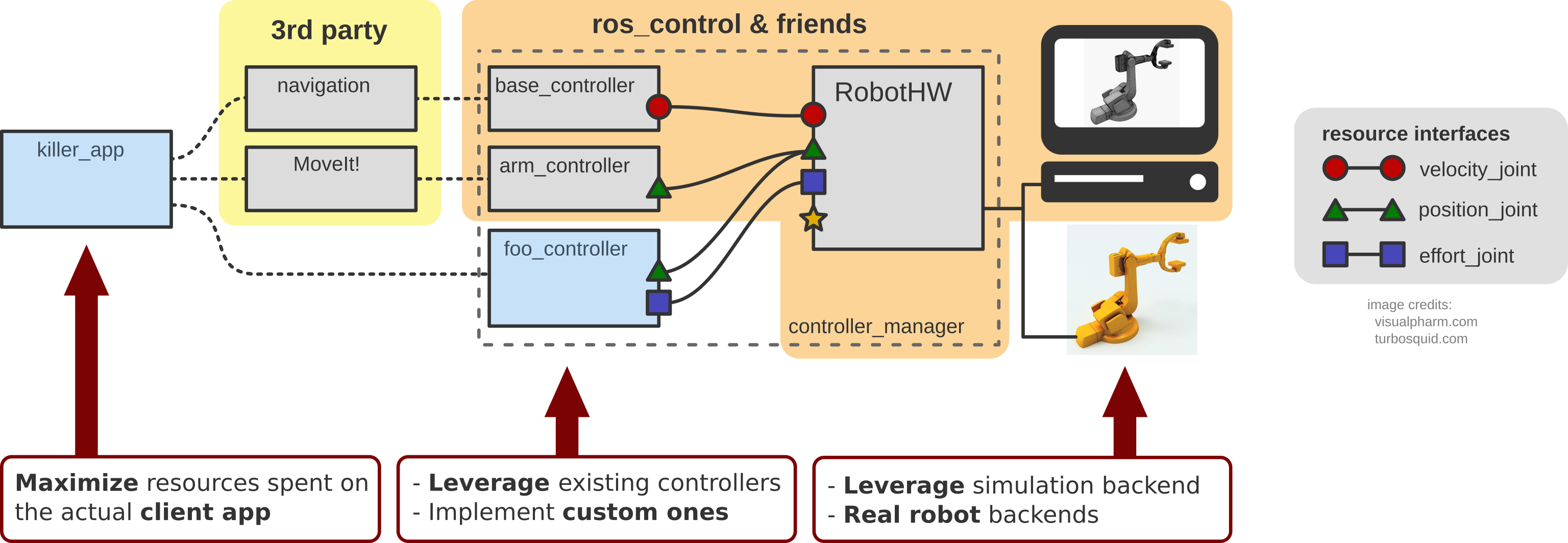
In recent years the Robot Operating System (Quigley et al. 2009) (ROS) has become the 'de facto' standard framework for robotics software development. The ros_control framework provides the capability to implement and manage robot controllers with a focus on both real-time performance and sharing of controllers in a robot-agnostic way. The primary motivation for a sepate robot-control framework is the lack of realtime-safe communication layer in ROS. Furthermore, the framework implements solutions for controller-lifecycle and hardware resource management as well as abstractions on hardware interfaces with minimal assumptions on hardware or operating system. The clear, modular design of ros_control makes it ideal for both research and industrial use and has indeed seen many such applications to date. The idea of ros_control originates from the pr2_controller_manager framework specific to the PR2 robot but ros_control is fully robot-agnostic. Controllers expose standard ROS interfaces for out-of-the box 3rd party solutions to robotics problems like manipulation path planning (MoveIt! (Chitta, Sucan, and Cousins 2012)) and autonomous navigation (the ROS navigation stack). Hence, a robot made up of a mobile base and an arm that support ros_control doesn't need any additional code to be written, only a few controller configuration files and it is ready to navigate autonomously and do path planning for the arm. ros_control also provides several libraries to support writing custom controllers.
Overview
Packages and functionalities
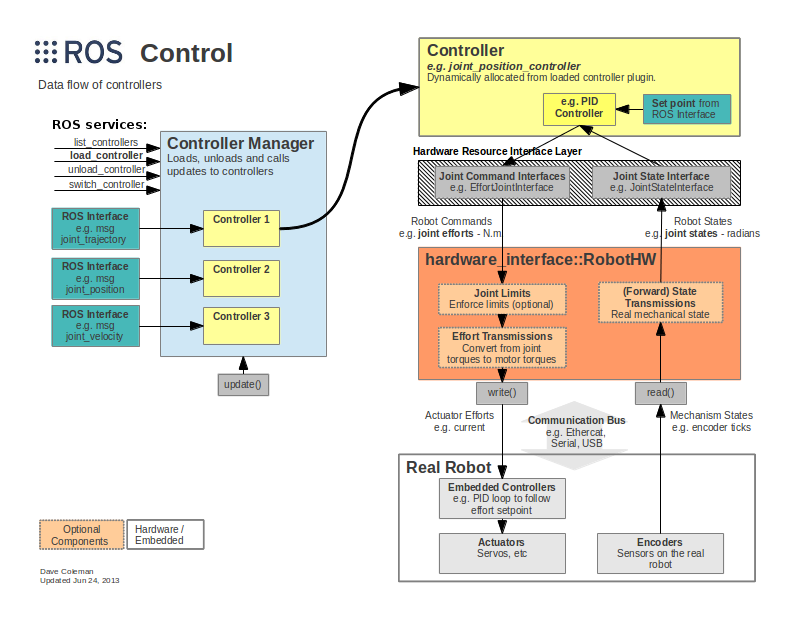
The backbone of the framework is the Hardware Abstraction Layer, which serves as a bridge to different simulated and real robots. This abstraction is provided by the hardware_interface::RobotHW class; specific robot implementations have to inherit from this class. Instances of this class model hardware resources provided by the robot such as electric and hydraulic actuators and low-level sensors such as encoders and force/torque sensors. It also allows for integrating heterogeneous hardware or swapping out components transparently whether it is a real or simulated robot.
There is a possibility for composing already implemented RobotHW instances which is ideal for constructing control systems for robots where parts come from different suppliers, each supplying their own specific RobotHW instance. The rest of the hardware_interface package defines read-only or read-write typed joint and actuator interfaces for abstracting hardware away, e.g. state, position, velocity and effort interfaces. Through these typed interfaces this abstraction enables easy introspection, increased maintainability and controllers to be hardware-agnostic.
The controller_manager is responsible for managing the lifecycle of controllers, and hardware resources through the interfaces and handling resource conflicts between controllers. The lifecycle of controllers is not static. It can be queried and modified at runtime through standard ROS services provided by the controller_manager. Such services allow to start, stop and configure controllers at runtime.
ROS Control overview
Furthermore, ros_control ships software libraries addressing real-time ROS communication, transmissions and joint limits. The realtime_tools library adds utility classes handling ROS communications in a realtime-safe way. The transmission_interface package supplies classes implementing joint- and actuator-space conversions such as: simple reducer, four-bar linkage and differential transmissions. A declarative definition of transmissions is supported directly with the kinematics and dynamics description in the robot's Universal Robot Description Format (URDF) (Willow Garage 2009) file. The joint_limits_interface package contains data structures for representing joint limits, methods to populate them through URDF or yaml files and methods to enforce these limits. control_toolbox offers components useful when writing controllers: a PID controller class, smoothers, sine-wave and noise generators.
The repository ros_controllers holds several ready-made controllers supporting the most common use-cases for manipulators, mobile and humanoid robots, e.g. the joint_trajectory_controller is heavily used with position-controlled robots to interface with MoveIt!. Finally, control_msgs provides ROS messages used in most controllers offered in ros_controllers.
ros_control was conceptualized by Sachin Chitta at Willow Garage Inc. and initial design and implementation was done by Sachin Chitta (then at Willow Garage), Wim Meussen, Vijay Pradeep and Eitan Marder-Epstein (then at HiDOF) before being released open-source.
ros_control is released as binary packages with each new version of ROS, source code is hosted at the ros-controls Github organization. Documentation on behaviour, interfaces, doxygen-generated pages and tutorials can be found at ros_control and ros_controllers. For a thorough presentation we invite the interested reader to watch the talk given at ROSCon2014 (Adolfo Rodríguez Tsouroukdissian, n.d.).
Robots using ros_control
Being a mature framework, ros_control is widely applied to both production and research platform robots. A few examples where the control system is implemented with ros_control are:
- Clearpath Robotics' outdoor mobile robots: Grizzly, Husky, Jackal (“New Universal Robots Driver Makes Manipulation Research Easier,” n.d.), and OTTO Motors' industrial indoor mobile robots: OTTO 1500, OTTO 100
- The "Twil" robot at Federal University of Rio Grande do Sul (Lages 2017)
- The quadruped robots HyQ and HyQ2Max (Semini et al. 2011, Semini et al. (2017)) at Istituto Italiano di Tecnologia
- NASA's humanoid and biped robots: Valkyrie & Robonaut (N. A. Radford et al. 2015, Hart et al. (2014), Badger et al. (2016))
- PAL Robotics' humanoid, biped and mobile robots: REEM, REEM-C, PMB2, Tiago and Talos (Stasse et al. 2017)
- Shadow Robot's anthropomorphic, highly sensorized and precise Shadow Hand (Meier et al. 2016)
- Universal Robots' industrial arms: UR3, UR5 (Andersen 2015)
References
Adolfo Rodríguez Tsouroukdissian. n.d. “[ROSCon2014] Ros_control: An Overview.” https://vimeo.com/107507546.
Andersen, Thomas Timm. 2015. “Optimizing the Universal Robots ROS Driver.” Technical University of Denmark, Department of Electrical Engineering; http://orbit.dtu.dk/en/publications/optimizing-the-universal-robots-ros-driver(20dde139-7e87-4552-8658-dbf2cdaab24b).html.
Badger, Julia, Dustin Gooding, Kody Ensley, Kimberly Hambuchen, and Allison Thackston. 2016. “ROS in Space: A Case Study on Robonaut 2.” In Robot Operating System (ROS), 343–73. Springer. doi:10.1007/978-3-319-26054-9_13.
Chitta, Sachin, Ioan Sucan, and Steve Cousins. 2012. “Moveit![ROS Topics].” IEEE Robotics & Automation Magazine 19 (1). IEEE: 18–19.
Hart, Stephen, Paul Dinh, John D Yamokoski, Brian Wightman, and Nicolaus Radford. 2014. “Robot Task Commander: A Framework and IDE for Robot Application Development.” In IEEE/RSJ International Conference on Intelligent Robots and Systems (IROS 2014), 1547–54. IEEE. doi:10.1109/IROS.2014.6942761.
Lages, Walter Fetter. 2017. “Parametric Identification of the Dynamics of Mobile Robots and Its Application to the Tuning of Controllers in ROS.” In Robot Operating System (ROS), 191–229. Springer. doi:10.1007/978-3-319-54927-9_6.
Meier, Martin, Guillaume Walck, Robert Haschke, and Helge J Ritter. 2016. “Distinguishing Sliding from Slipping During Object Pushing.” In IEEE/RSJ International Conference on Intelligent Robots and Systems (IROS 2016), 5579–84. IEEE. doi:10.1109/IROS.2016.7759820.
“New Universal Robots Driver Makes Manipulation Research Easier.” n.d. https://www.clearpathrobotics.com/2016/02/new-universal-robots-driver-makes-manipulation-easier.
Quigley, Morgan, Ken Conley, Brian Gerkey, Josh Faust, Tully Foote, Jeremy Leibs, Rob Wheeler, and Andrew Y Ng. 2009. “ROS: An Open-Source Robot Operating System.” In ICRA Workshop on Open Source Software, 3:5. 3.2. Kobe; http://www.willowgarage.com/papers/ros-open-source-robot-operating-system.
Radford, Nicolaus A., Philip Strawser, Kimberly Hambuchen, Joshua S. Mehling, William K. Verdeyen, A. Stuart Donnan, James Holley, et al. 2015. “Valkyrie: NASA’s First Bipedal Humanoid Robot.” Journal of Field Robotics 32 (3): 397–419. doi:10.1002/rob.21560.
Semini, Claudio, Victor Barasuol, Jake Goldsmith, Marco Frigerio, Michele Focchi, Yifu Gao, and Darwin G Caldwell. 2017. “Design of the Hydraulically Actuated, Torque-Controlled Quadruped Robot HyQ2Max.” IEEE/ASME Transactions on Mechatronics 22 (2). IEEE: 635–46. doi:10.1109/TMECH.2016.2616284.
Semini, Claudio, Nikos G Tsagarakis, Emanuele Guglielmino, Michele Focchi, Ferdinando Cannella, and Darwin G Caldwell. 2011. “Design of HyQ–a Hydraulically and Electrically Actuated Quadruped Robot.” Proceedings of the Institution of Mechanical Engineers, Part I: Journal of Systems and Control Engineering 225 (6). SAGE Publications Sage UK: London, England: 831–49. doi:10.1109/IROS.2010.5651548.
Stasse, Olivier, Thomas Flayols, Rohan Budhiraja, Kevin Giraud-Esclasse, Justin Carpentier, Andrea Del Prete, Philippe Soueres, et al. 2017. “TALOS: A New Humanoid Research Platform Targeted for Industrial Applications.” https://hal.archives-ouvertes.fr/hal-01485519.
Willow Garage. 2009. “Universal Robot Description Format (URDF).” http://wiki.ros.org/urdf/.